Showing posts with label cinema. Show all posts

Mar 7, 2016

Remembering David Rakoff

In 2012 I saw David Rakoff give this talk and performance, three months before he died. I just heard it again, rebroadcast on the radio, and found a video of it that I've put at the bottom of this post. A lot of what he says resonates with me both as a person of difference and as a person of dis/ability:
It was an exercise in humiliation and trying to make myself as invisible as possible. 
That was how he felt going to dance classes as a young man. That was how I felt in gym class as a kid. The difference between us that as a kid in gym class, I was coming to terms with disability, and the young David Rakoff wasn't. Not yet.

On becoming dis/abled, he says:
Everybody loses ability—everybody loses ability as they age. If you're lucky, this happens over the course of a few decades.
David Rakoff's "if your lucky" referred to his cancer and resulting string of operations, the last of which left him with a flail limb, meaning that he could neither move nor feel anything in his left arm. His descriptions for accommodating to this disability, though different from those that a person with low vision performs, are pretty familiar in their perfunctory absurdity:   
If I retained anything from dancing, it's a physical precision that certainly helps in my new daily one-armed tasks. They're the same as my old two-armed chores. They're not epic or horrifying. Some of them don't even take much longer, but they're all to one degree or another, more annoying than they used to be, requiring planning, strategy, and a certain enhanced gracefulness. 
Oral hygiene: Hold the handle of the toothbrush between your teeth the way FDR or Burgess Meredith playing The Penguin bit down on their cigarette holders. Put the toothpaste on the brush, recap the tube, put it away... Then reverse the brush and put the bristles in your mouth, proceed. 
Washing your right arm: Soap up your right thigh in the shower, put your foot up on the edge of the tub, and then move your arm over your soapy lower limb back and forth like an old-timey barbershop razor strop. 
Grating cheese: Get a pot with a looped handle, the heavier the better. This will anchor the bowl that you want the cheese to go into. Put the bowl into the pot. Now take a wooden spoon and feed it through the handle of the grater and the loop of the pot, and then tuck the end down into the waistband of your jeans. (Clean underpants are a good idea.) Jam yourself up against the kitchen counter and go to town.
In memory, here's David Rakoff's complete talk and performance:


After he died, This American Life ran an hour-long tribute to David Rakoff's life and work. Listen here.

Jan 9, 2016

Blind Book #2: The Country of the Blind


One short story, told three different ways: print, radio, and animated film.

H.G. Wells mastered science fiction by generating stories from simple questions. Questions like, "What would a man do if he became invisible?" or "What if our planet were attacked by aliens?" or "What would life on Earth be like many millennia in the future?" yielded some the most well-known novels, radio plays, and films in over a century of sci fi. Wells' questions also spun into shorter stories, with "what-ifs" that, like The Time Machine, put an ordinary person from his day into another world. The exploration is twofold in these stories: the protagonist must contend with the strangeness of that world and its inhabitants who, in turn, try to figure out their unusual visitor. As readers, we become a third fold, interpreting the experiences on both sides of that relationship.

"The Country of the Blind" first ran as a magazine piece in 1904. Wells later published it with a very different ending, and every adaptation has hence taken liberties with it, leaving it up to readers (or viewers or listeners) to guess how any given version will end. The story lends itself to the sightless realm of audio theatre, and was perfect fodder for the radio suspense series Escape, which dramatized it in 1947. This restored version of that broadcast is pretty faithful to Wells' original, though the tagline about "a band of blind men who want your eyes" misses the essence of the piece by over-demonizing the story's blind populace. Listen and discern, as Wells did, how "In the country of the blind, the one-eyed man is not king."

This wordless 1995 Russian animation took even greater liberties with the original story and all sorts of stuff could be read into it as post-Soviet, post-Industrial, and even post-Medieval allegory. This all-pictures-no-words version makes for a nice counterpoint to radio, though any blind person who "saw" would think it funny how the people are depicted moving about in a place completely familiar to them:


Mar 25, 2015

Blind Film #10: They Live

The promise of glasses, as a way to see what's right in front of our faces, has never been more clear than Roddy Piper's revelation in the 1988 cult classic, They Live:

Mar 16, 2015

Blind Film #9: Genghis Blues

Paul Pena's story is a good one. With a background playing Portuguese music, American blues and rock, he became obsessed with Tuvan throat singing back when few westerners had ever heard of it. My pick for most moving scene from this film is when Pena uses a Braille reader on a page of Tuvan text, then on a Tuvan-Russian dictionary before he can translate the Russian translation into English, I identify with the obsessive quality that drives someone with low vision to take great pains (and yes, it is a little bit painful) to do something like that.

R.I.P. Paul Pena and Kongar-Ol Ondar. Thanks for bringing so many of the planet's great musicians together and for sharing your brilliant artistic visions with the world.

Mar 3, 2015

Blind Film Special: Tommy Edison

The reel Tommy Edison. Who needs lightbulbs? Let this guy guide you through the dark:


Check out his YouTube channel, and his other YouTube channel.

Feb 25, 2015

Blind Film #8: The importance of the worst cartoon ever made

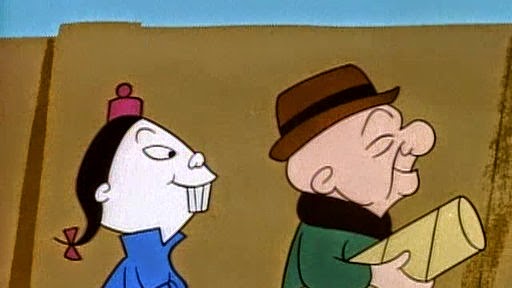
What else can one say about that one-joke wonder, Mr. Magoo? As a kid I suffered through this poorly animated cartoon about an oblivious old myopic white guy and his manservant Charlie, depicted as a pigtailed, slanty-eyed, bucktoothed, Asian stereotype who's always shouting, "Mistah Magloo!" and calling the man "Bloss."

Hoo boy. A popular cartoon that's racist and ableist. I'd like to say that I can't believe I was allowed to watch it, or even that the TV station was allowed to air it. I'd also like to say that it's been discarded and forgotten as an antiquated artifact from the pre-PC era, but none of these statements would be true: Magoo lives on into another century, perpetuated in part by Disney's live-action remake. They even tried to PC-ify their version by transforming Charlie into a pan-global female love interest for Magoo's nephew, and then inserted this end-of-film disclaimer:


Siskel and Ebert sum all of it up in their review:


So Disney made a crappy film, based on a crappy cartoon. But Magoo serves an important role in popular culture. While other movies portray people with visual disabilities as having absolutely no vision, Magoo is one of the few mainstream media representations of someone with low vision. He's become an ableist cultural icon, an insult lobbed at people who act like they don't see something that's right in front of their faces. Magoo also gives context for understanding how people with disabilities can be misunderstood when they pass as abled—like a very nearsighted person who doesn't walk around with dark glasses and a white cane. To Magoo's credit, his antics are somewhat accurate. Too bad they couldn't have done that with a good film.

Feb 24, 2015

Believing is Seeing: Blind Film #7

The film's title asks, What the Bleep Do We Know? One thing I know is that the phrase, "A wonderful story that I believe is true," might not be the strongest line to open a scientific statement. Many scholars and scientists have dismissed this movie as such tosh peddled by charlatans, but in light of mirages and other illusions that we experience on the sea, why not this phenomenon? Provide your anwers in the comments. I'll give mine in a future post.

Feb 19, 2015

A Clockwork ERG Simulation: Blind Film #6

Sometimes blindness takes the form of someone being forced to see something one doesn't want to see—something painful…physically, emotionally, or both.

An electroretinograph (onomatopoeically abbreviated "ERG") is a test that measures the electrical responses of  cells in the retina—rods, cones, ganglions, and so on. When they administer it, they dose the patient with some very strong eyedrops that can dilate the pupils (and severely blur the vision) for up to three days. Then they pry the eyes open and insert an oversized contact lens attached to an electrode, along with several other electrodes that get taped to the face and scalp…that's the easy part. Next they subject the patient to three barrages of flashing lights: one minute of metronomic blue flashes (painful), one minute of metronomic red flashes (worse), and then 10 minutes of stroboscopic white light (unquantifiably bad), after which they remove the electrodes and the lens and repeat the whole thing with the other eye.

I've had the ERG three times in my life with varying results. In my teenage years between session #1 and #2, I saw Stanley Kubrick's film A Clockwork Orange, about a gang of longjohn-wearing protopunk hooligans on a spree of what they termed "ultraviolence." To cure one of them of his psychopathic behavior, they strap him into a cinema seat, pry open his eyelids, and force him to watch footage of Nazi warcrimes while an orderly administers drops of fluid into his eyes, an experience that, from where I sat, was astonishingly like the ERG.

Sometimes blindness takes the form of someone being forced to see something one doesn't want to see—something painful…physically, emotionally, or both. That pain can be illuminating, and it can also be blinding. The line between the two is a fine one indeed.

Feb 15, 2015

Blind Film #5: Scent of Machismo

Pacino plays the blind card to win Best Actor at 1992's Academy Awards. Scent of a Woman's pity party plot revolves around a macho ex-army colonel whose manhood has been besmirched by his disability. This scene's extra asset is a pre-gentrified view of Brooklyn's DUMBO neighborhood. You'd hit half of Etsy if you drove like this down there today:


My favorite part of this scene is at the end when the ex-army colonel uses his privilege to mask his disability. The same year this came out, Odd Squad's video for "Can't See It" also featured clips of a blind man driving, but unlike Al Pacino, MC Rob Quest is actually blind.

Feb 10, 2015

Blind Film #4: I'm Bah-Lined!

Anchorman 2?
Amazing.
Watch the scene.
Then read this review on the American Foundation for the Blind's website.

Feb 5, 2015

Blind Film #3: O'Brother, O'Dyssey

How many stories feature the blind seer? This one from O Brother Where Art Thou? is based on Tiresias in the Odyssey:

Feb 4, 2015

Blind Film #2: The Fabulous Destiny of Amélie Poulan (and her blind friend)

I once sat with a friend by the lake in Powderhorn Park in Minneapolis, and she described for me everything that I couldn't see—the bugs, the birds, the way the light played with the water. Looking at this clip, I wonder if she got the idea from Amélie. It's a good idea. Watch what happens after she leaves her blind friend:

Feb 3, 2015

Blind Film #1: Golden Age

So far I've posted several songs that reference or portray blindness. Now let's turn to cinema. Here's a memorable moment from L'Age d'Or (1930), the second collaboration between Luis Buñuel and Salvador Dali:

Jan 24, 2015

Blind Song #7: Would You Rather...

Etta James' turn to ask:

"Would you rather go blind,
or see someone you love walk away from you?"

It's an intense proposition, and Beyoncé gets to amp up the melodrama in this cover version—Thanks Hollywood:


What about you? Would you rather go blind than see someone you love walk away from you? If not, you'd be sighted and single, otherwise you'd be blind…and single? Or do you get to keep your relationship in exchange for losing your vision? Leave your answers in the comments below.

Jan 20, 2015

Blind Song #6: Elton Tom

When we put together a playlist for our Blind Games workshop, we found that depictions of blindness fell into a handful of archetypes. A fascinating one is when blindness gets linked to the supernatural.

In songs of love or devotion, being blinded is usually a metaphor for being struck by some higher power: Tom Waits' "Blind Love", Thomas Dolby's "She Blinded Me With Science", and Springsteen's "Blinded By The Light" are all examples.

Beyond pop songs, in many literary and theatrical traditions, lacking a sense of sight often comes with special abilities attached: Tiresias the blind oracle of Thebes, the blind swordsman in the Zatochi franchise of samurai films, and Marvel Comics' Daredevil all fit into that category of "blind superheroes".

In 1969, The Who brought these theatrical and pop traditions together in their rock opera Tommy, recreated for the screen in 1975. Here Elton John takes a scornful look at Roger Daltrey's superpowers in one of the film's many pivotal scenes:

Jan 13, 2015

Blind Song #5: Un-avoiding Björk

One of the people who came to all three sessions of Blind Games this weekend sent us this musical number from the 2000 film Dancer in the Dark. The first time I saw that film, I sobbed my brains out and then spent two days in bed recovering. No joke.

As a kid whose parents debated whether or not to have a child for risk of passing an eye disease onto him (me), my reaction was a personal one: Björk plays a woman who's losing her vision and trying to raise funds to save her own son from going blind. She faces oppression at every turn—for being disabled, for being a woman, for being an artist, for being an immigrant, for being a single mom, and she also has these lapses into an illusory world that are on one hand a decay of mental health, and on the other hand a fantastic alternate reality filled with color, music and dancing.

I have rarely felt as mortified as I did at the end of Dancer in the Dark when all of Björk's hardships come to a head. It's one of my favorite films and I've avoided it ever since seeing it. Here's to facing fear:

Jan 8, 2015

Blind Song #3: Dr. No

Like all good nursery rhymes, this ditty's roots are politically charged and a tad violent. The first 007 flick brings us full circle and manages to further ridicule blindness: